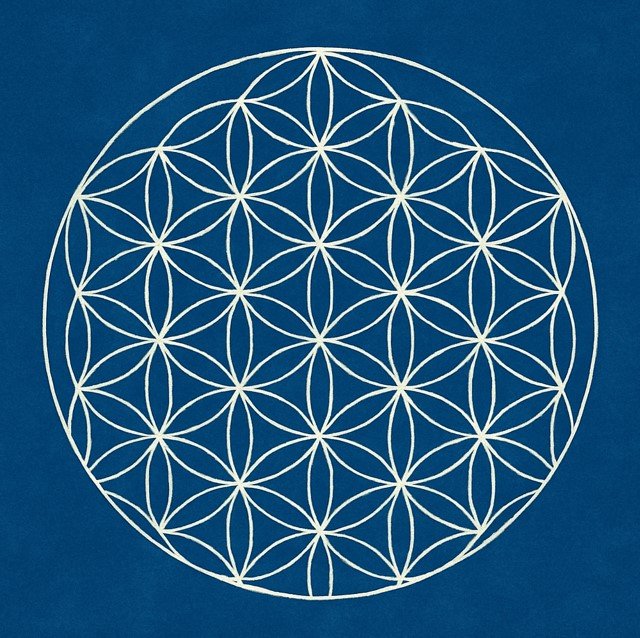
The Flower of Life is a captivating geometric symbol that builds upon the foundation of the Seed of Life, a pattern formed by seven overlapping circles. The Flower of Life expands this concept by adding more interconnected circles, creating a complex, symmetrical design resembling a flower. This symbol is regarded as one of the most sacred and profound geometric patterns, believed to hold the secrets of the universe, including the shapes of the Platonic solids—tetrahedron, cube, octahedron, dodecahedron, and icosahedron—which are fundamental to understanding cosmic structures.
Origins and Historical Significance
The Flower of Life has been found in numerous cultures and civilizations throughout history, from ancient Egyptian temples, such as the Temple of Osiris in Abydos, to artifacts in China, India, and medieval Europe. Believed to date back thousands of years, this symbol is a central element in esoteric and spiritual traditions. In many cultures, the Flower of Life is seen as a representation of creation and the interconnectedness of all living things, symbolizing cosmic harmony and universal balance.
Spiritual and Energetic Meanings
Beyond its visual beauty, the Flower of Life carries profound spiritual significance. It is considered a visual representation of the life force energy—known in various traditions as “prana” or “chi”—that flows through all living beings, connecting them in an invisible web of life. Meditating on the Flower of Life can help activate this vital energy, promoting physical, emotional, and spiritual healing. Practitioners use this symbol to enter deep states of consciousness, explore connections with universal energies, and gain insight into the cycles of creation.
Practical and Modern Applications
Today, the Flower of Life is widely used in spiritual and therapeutic practices. In meditation, the symbol helps align chakras and enhance mental clarity. In Feng Shui, it is placed in spaces to harmonize energy and attract positive vibrations. Artists and designers incorporate the pattern into artwork, jewelry, and even architecture due to its mesmerizing symmetry.
A fascinating aspect of the Flower of Life is its connection to mathematics and sacred geometry. The symbol embodies proportions that reflect the golden ratio and the Fibonacci sequence, elements considered fundamental to nature and the universe. For instance, its repetitive structure can be observed in natural patterns, such as the arrangement of flower petals or sunflower seeds.
The Flower of Life in Science and Technology
Modern interest in the Flower of Life extends beyond spirituality. Researchers and scientists have explored its relevance in fields like quantum physics and biology, noting similarities between its pattern and molecular structures or energy networks. Some theories suggest that the Flower of Life may hold clues to the fundamental structure of space and time, acting as a kind of “code” for the universe.
How to Use the Flower of Life
For those looking to integrate the Flower of Life into their lives, there are several practical ways to do so:
- Meditation: Gaze at or draw the symbol during meditation to connect with its energy.
- Decor: Incorporate the symbol into your home through wallpapers, paintings, or decorative items to promote harmony.
- Jewelry: Wear pendants or bracelets featuring the Flower of Life to keep its energy close.
- Study: Explore sacred geometry to deepen your understanding of the symbol’s mathematical and spiritual connections.
Conclusion
The Flower of Life is more than an aesthetic symbol—it is a gateway to understanding universal unity and harmony. Whether used for meditation, decor, or exploring the mysteries of the cosmos, this symbol continues to inspire and captivate people worldwide. Through its complexity and beauty, the Flower of Life reminds us that everything in the universe is interconnected, inviting us to explore both our inner world and the vastness of existence.
